Lake Superior Goodness

Storing your drysuit for the season

It’s a good idea to clean and store all of your paddling gear for the winter.  Ideally before the snow comes and you start thinking about skiing and snowshoeing and whatever other winter activities you partake in that are decidedly more interesting than putting summer gear away.

Kokatat has some good ideas for storing your dry suit and dry top since they have components that age over time if not stored properly.

Protect your investments

  • Prior to storage wash gaskets with a gentle soap to remove contaminants (sunscreen, insect repellents, lotions). Treat latex gaskets every 4-6 weeks, inside and out, with 303 Protectant™. Rub it in and let sit for a few minutes before wiping clean with an absorbent cloth until gasket is dry. When using 303 Protectant™ avoid getting it on other parts of the garment.
  • Wash your garment.  When washing, always follow sewn-in care instructions. With dry suits and dry tops Kokatat recommends using warm water, delicate cycle, gentle powdered soap (or Nikwax® Tech Wash™), with no bleach or harsh chemicals, and high water volume, in a front loading machine. Rinse well (which may mean running it through a second time, inside out with no soap OR use a warm shower). Line dry.
  • To restore DWR (Durable Water Repellent) or water beading to the outside of a garment, Kokatat recommends Granger’s XT Proofer Spray or Nikwax® TX-Direct Spray-On™. When using the Spray-On product apply when garment is damp. Line dry. Heat is necessary to set the DWR into the fabric (the bottle tells you to use a dryer). Kokatat recommends using an iron, on medium to low heat. Keep the iron moving. DO NOT iron gaskets or zippers.
  • Keep the garment clean, rinsed as needed, and hang dry. If the suit will be stored in a clean environment, the zipper should be left open. This will help alleviate pressure on the sealing elements. In dusty or dirty environments, store with the zipper closed. Store either hanging or loosely rolled. Do not store dry suits or tops in the same room with gas appliances or other combustion exhaust. Do not store dry suits or tops in excessively hot and/or humid locations or where latex gaskets are in direct sunlight. High heat and humidity, extreme dryness, exhaust fumes from cars or gas appliances and exposure to UV and ozone can destroy or shorten the life of gaskets.

Read the full article.

See other self repair guides from Kokatat.

Changes in the Climate And a Windier Lake Superior

Chalk up another effect of climate change: it’s getting windier over Lake Superior.

That is the conclusion of a study by scientists who have looked at the effects of increasing surface water temperatures in the lake and air temperatures over it. The water has warmed faster than the air, creating instability in the air mass that results in stronger winds.

Ankur R. Desai of the University of Wisconsin-Madison, an author of the study in Nature Geoscience, said the effect was due to ice, or lack of it.

“Less ice in the winter means stronger winds in the summer,” Dr. Desai said.

Ice coverage of Lake Superior has declined in recent decades, which means that the lake starts to warm sooner, becoming stratified. The earlier this stratification occurs, Dr. Desai said, the warmer the top layer gets in the summer.

Data from buoys and satellites showed that this warming outpaced that of the air above it. That means the thermal gradient between the two was reduced.

A large thermal gradient makes for stable air, which is why the wind often dies down at night, when the ground cools. In this case, with a smaller gradient, instability increased. This was confirmed by data showing that average wind speeds over the lake have increased by 5 percent per decade since the 1980s.

The researchers also showed that higher winds increase the speed of currents in the lake. That, Dr. Desai said, should increase the amount of mixing of the lake’s layers, affecting nutrient distribution of nutrients and, ultimately, the organisms in the water.

© 2009 by the New York Times Company, Tue Nov 17 2009

Gales of November come early.

As we are anticipating this year’s Gales of November photography workshop with pro Rob Stimpson, Lake Superior decided to give us a little show of what she can dish out.  Winds were from the west at about 30knots (gale force) and gave us some good wave action.  Here are a couple of shots plus a short video taken from the front of the lodge.

Things you find on the beach…

helicoptors on the shore of Lake Superior

It’s amazing what one finds on the beach on the way to work in the morning.  Apparently these folks had to make an emergency landing when the ceiling lowered and they couldn’t make it to Wawa airport.

Unique way to get your kayak around.

This guy showed up at the lodge last week and this is how he gets his kayak around with him:

Kayak trailer for your motorbike.

Sault College Fall Camp a success

This past week the Second year Adventure Parks and Recreation students from Sault College have been here for their “Fall Camp”.  They have had kayak, canoe and mountain bike instruction all week.  The plan was to go on an overnight trip on to Lake Superior and of course, being September, the lake decided not to cooperate so the group of 15 students and 3 instructors headed on a day trip down the Michipicoten River.

Fly like an Eagle…

…swim with the salmon. It’s one of the great things about this area in the fall. The salmon are running up the Michipicoten river and so you are most likely guaranteed to see an eagle or two or three scouting out the area looking for a feast.

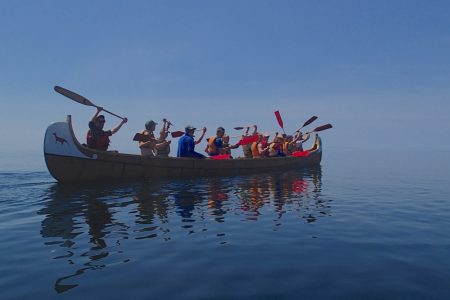
The following shots were taken from some folks doing an Eco-tour via canoe down the river not that long ago.


350 Kayak-Style

Earlier this year a bunch of us from Naturally Superior Adventures traveled down to the other end of the lake to help instruct at the bi-annual Inland Sea Symposium (Washburn, Wisconsin).  This year one of the goals was to create a very large three, five and zero using kayakers in their kayaks.  Why a 350?  350 is the number that leading scientists say is the safe upper limit for carbon dioxide—measured in “Parts Per Million” in our atmosphere. 350 PPM—it’s the number humanity needs to get back to as soon as possible to avoid runaway climate change.
By creating this, the organizers were hoping to create more of an awareness about climate change.  Want more information on this movement?  Go to www.350.org.

You may also notice that this blog fights climate change.  I’d say after such a bizarre summer as this one just past, we should all be a little more concerned about climate change.

350 kayak-style

River Mouth Daily Shots

This is the view from my window.  Every day (well most days) I stick my camera out the window on the ledge and take a picture of the Michipicoten River as it flows into Lake Superior.  I started in May before there were even leaves on the trees so you can see the foilage grow as well as the sand spit change shape over the course of the season.  I hope to continue right up until November so I’ll be adding another post at the end of the season.

River" />River" type="application/x-shockwave-flash" allowfullscreen="true" width="425" height="355" > Mouth Daily Shots

What for the Mafor?